Why Onboarding on 100+ Screens Is Necessary
In short
Reaching a complex goal takes many actions. Onboarding is a sequence of actions that must raise the user’s initial motivation to the level the goal’s complexity demands; each action has its own complexity and adds its own motivation, and some lower it for a while to make later ones work. Noom’s 113 screens alternate data gathering with intermediate results.
An onboarding strategy entails a series of sequential actions designed to increase user motivation (initial motivation - IM) to reach the desired level (goal complexity - GC).
IM + (AM1 + ... AMn) ≥ GC
where "n" is the number of strategic onboarding actions.
In this case, each action has its own:
- CA - complexity of action
- AM - additional motivation.
So, the condition for achieving the onboarding goal is as follows:
IM + ((AM1 - CA1) + ... (AMn - CAn)) ≥ GC
- Complex strategies are built on the understanding that certain actions may temporarily decrease motivation but are necessary for subsequent actions that will increase motivation and compensate for the initial loss.
For example:
Noom is №73 in Health & Fitness, 113 onboarding screens!
They combine information-gathering blocks with intermediate results blocks to increase user motivation:
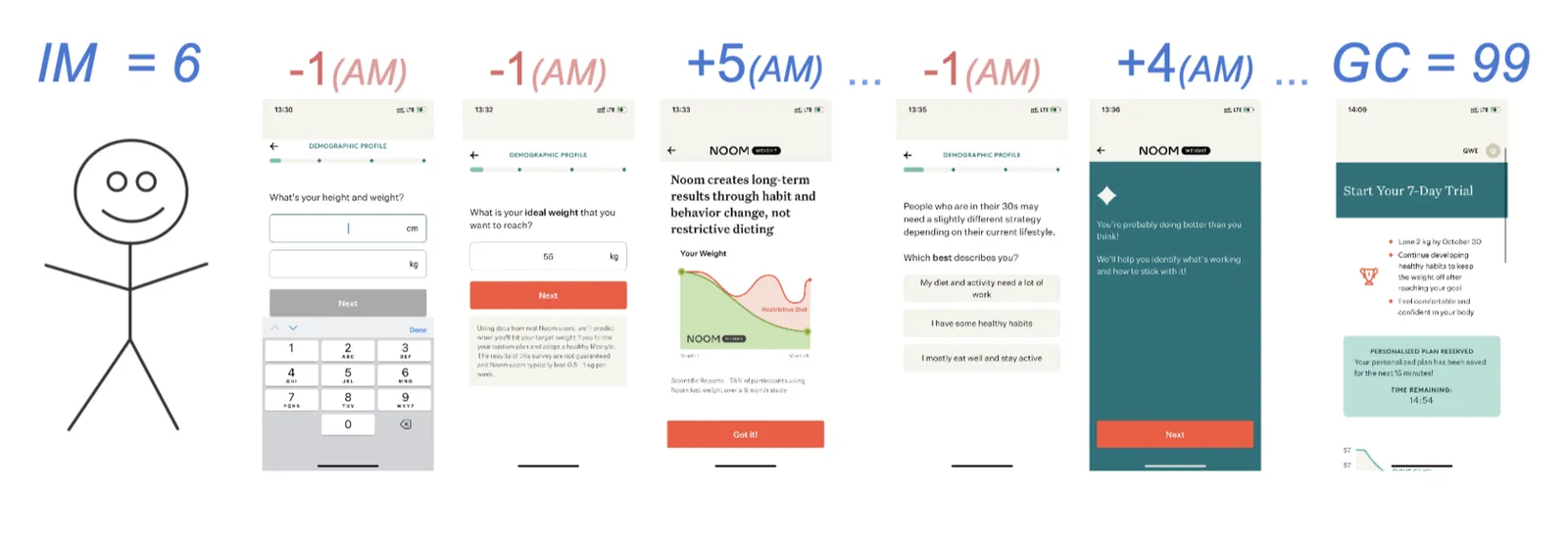
- Remember: If motivation drops to zero, users are likely to leave
Key takeaways
- An onboarding strategy is a sequence of actions that raises initial motivation (IM) to the level set by goal complexity (GC).
- Each action has its own complexity (CA) and additional motivation (AM); the goal is reached when IM plus the net gain of all actions is at least GC.
- Complex strategies accept that some actions temporarily lower motivation, because they enable later actions that raise it and compensate for the loss.
- Noom, №73 in Health & Fitness, runs 113 onboarding screens that combine information-gathering blocks with intermediate results.
- If motivation drops to zero, users are likely to leave.